
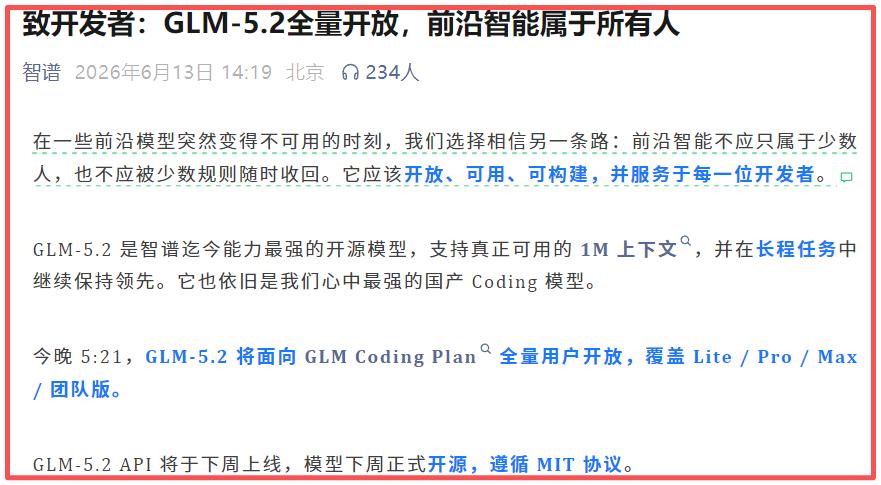
On June 13, Anthropic’s flagship models Fable-5 and Mythos-5 announced their unavailability outside the U.S., causing panic among global developers. That afternoon, Zhiyuan announced the full open-source release of GLM-5.2, supporting a million-level context, set to be released under the MIT license next week.
The opening statement, “At a time when some cutting-edge models suddenly became unavailable, we choose to believe in another path,” resonated with many.
This move comes during a sensitive period for Zhiyuan, with a shareholder meeting to review an IPO proposal on June 22, a significant share unlock on July 8, and a sharp decline in Hong Kong stock prices. It appears to be more than just a technical iteration; Zhiyuan may be attempting to hedge “capital uncertainty” with “technical certainty.”
Amid the panic caused by competitors’ service interruptions, Zhiyuan is turning the crisis narrative into a message of reassurance: “Not only are we operational, but we are also providing you with the weights.” The MIT license allows for commercial use, modification, and integration into businesses without returning code, aiming to win developer loyalty through openness.
The business logic is clear: free weights serve as a funnel, aiming to drive developers into the ecosystem, ultimately monetizing through API calls, Coding Plan subscriptions, and enterprise deployments.
The question remains: can this “front-end profit for ecosystem growth, back-end MaaS monetization” business model support Zhiyuan’s profitability roadmap presented during the A-share IPO? Will the open-source release further pressure profits? This is the most pressing issue at hand.
Providing “Verifiable Signals”
Zhiyuan’s technical capabilities are unquestioned. GLM-5.1 has demonstrated competitive programming abilities, and GLM-5.2 enhances context to 1M, addressing previous shortcomings. The official claim that GLM-5.2 is their “strongest open-source model to date” is likely valid.
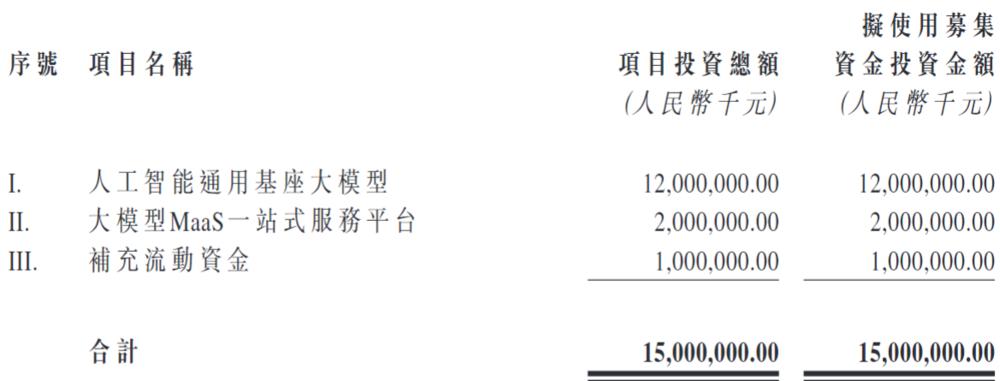
However, the harsh reality of the large model industry is that technical strength does not equate to a compelling narrative for approval. The Sci-Tech Innovation Board is not assessing technical prowess or rankings, but rather asking, “Where is the end of the money-burning for a general foundation? How can a 2 billion investment in a MaaS platform transition from ’losing money to gain exposure’ to ‘achieving economies of scale’?”
This is what Zhiyuan must address during its A-share fundraising.
Zhiyuan previously attempted to justify continued investments in foundational models and potential profitability using “Token index consumption” and “extreme cost-effectiveness” in their 2025 report. However, regulators are not interested in stories; they require a closed-loop business logic.
The three-step release of GLM-5.2 seems to respond directly to this need.
First, full open access without tiered restrictions. Unlike the 5.1 era, where complete capabilities were locked behind a Pro/Max paywall, 5.2 unlocks the “truly usable 1M context” across all versions: Lite/Pro/Max/Team. This represents a productivity leap from “understanding fragments” to “seeing the whole picture” and directly targets the highest willingness to pay scenarios: enterprise code repository comprehension and long-range agent tasks, making “usability” a production issue.
Second, Zhiyuan’s MIT license provides a safety net. In the current context of competitors shutting down, enterprises can integrate GLM-5.2 into their products, conduct secondary development, or even deploy offline without worrying about “tightening licenses that could halt operations.” This positions GLM-5.2 as a business continuity insurance policy, elevating it to a survival narrative.
Third, an API will follow closely next week, quickly converting open-source enthusiasm into a paid traffic entry point.
Translating this into IPO language: if you’re questioning whether my MaaS can scale, I’m showing you developers are pouring in, and the next focus is on how many of them will stay and pay, providing the “verifiable signals” that regulators and the market need.
The Open Source Paradox: When “Free Weights” Collide with “Paid Retention”
Pushing the logic further, it’s essential to temper expectations: while GLM-5.2’s open-source release generates a traffic pulse, it also dismantles a portion of its revenue.
Why is this the case?
The 2025 report shows that localized deployment contributes 73.7% of Zhiyuan’s revenue, remaining its foundational base. Although many of Zhiyuan’s clients are from finance, government, and energy sectors, needing not just operational code but also industry fine-tuning, data sovereignty solutions, and accountability from the original manufacturer, the arrangement in the GLM-5.1 era that locked high-level capabilities behind Pro/Max objectively forced some enterprises to pay for full functionality.
With the current 5.2 full open access and MIT open-source weights available for free download, Zhiyuan has effectively dismantled this forced leverage. With the parameters now freely available, the negotiation mindset has shifted from “I want your capabilities” to “I have it myself; why should I pay you?”
Zhiyuan must prove that its on-site support, operations, and SLA guarantees (availability commitments, fault remediation mechanisms, etc.) can provide real accountability and responsible parties, covering the hidden costs and regulatory risks of self-built solutions with compliance endorsements (data sovereignty, audit trails, industry qualifications/internal controls).
Meanwhile, despite the rapid growth of its cloud-based MaaS business (with a revenue growth rate of 292.6% in 2025), this segment still operates at a loss.
The MIT full open-source of GLM-5.2 essentially uses current cash flow and R&D amortization to gamble on a highly risky assumption: developers will stay for the “sense of security” and willingly pay a premium for APIs and enterprise services in the future. However, for enterprises with self-building capabilities, the most rational choice is to download, self-deploy, and self-manage, rather than continuously pay for expensive APIs.
Thus, while GLM-5.2 may enhance Zhiyuan’s appeal during the A-share IPO window and provide “verifiable signals,” these signals do not constitute a closed loop. Whether it can fill the deep pit of “profit uncertainty” will ultimately be tested not by the number of likes and collections in the open-source community, but by the next financial report’s gross profit curve (especially the unit economic benefits of cloud-based MaaS, rather than merely betting on a surge in usage).
The true test is imminent: Q3 and Q4.
If subsequent disclosures (Q3, Q4 operational data/updated prospectus) can validate that as usage increases, the paid retention rate stabilizes and MaaS profitability improves with scale, then GLM-5.2 will have successfully transitioned from “narrative supplement” to “turning point.” Otherwise, the so-called ecological positioning may resemble an expensive giveaway to global developers, while Zhiyuan remains caught between “market value/unlock pressure + Sci-Tech Innovation Board’s scrutiny of profitability pathways,” continuing to struggle.
Comments
Discussion is powered by Giscus (GitHub Discussions). Add
repo,repoID,category, andcategoryIDunder[params.comments.giscus]inhugo.tomlusing the values from the Giscus setup tool.